


Standard Sofa Dimensions (in Feet, cm and Inches)
There is no single standard sofa size. There's a standard range, and then a hundred reasons a real sofa falls outside it. Arms, back height, seat depth, brand: they all move the numbers.
Before the sizes, let's fix what each measurement actually means, because half the confusion comes from people comparing different numbers and thinking they're the same one.
What the measurements mean
We'll use our TEDDY Sofa as the reference.
It's a clean example at 200 x 100 x 70 cm (6′7″ x 3′3″ x 2′4″), and every term below points at a real part of it.

- Width: side to side, the longest horizontal run. TEDDY Sofa: 200 cm (6′7″).
- Depth: front to back, from the front edge of the seat to the back of the sofa. TEDDY Sofa: 100 cm (3′3″).
- Height: floor to the top of the backrest. TEDDY Sofa: 70 cm (2′4″).
- Seat height: floor to the top of the seat cushion, the number that decides how easy it is to sit down and stand up. TEDDY Sofa: 34 cm (1′1″), low and loungy.
Two more you'll meet further down:
- Seat depth (front to back of the usable seat, not the whole sofa)
- Arm height (floor to the top of the arm). Those stay fairly constant across sizes, so they get their own section.
When you read any sofa spec, the order to expect is width x depth x height.
Standard sofa dimensions at a glance
Every size in one place, centimetres first with feet alongside.
EU (centimetres)
Sofa |
Width |
Depth |
Height |
|---|---|---|---|
Loveseat (2-seat) |
132–183 cm |
76–102 cm |
71–102 cm |
Apartment (compact 3) |
152–198 cm |
86–97 cm |
71–91 cm |
Standard (3-seat) |
183–244 cm |
81–102 cm |
76–102 cm |
Large (4-seat) |
244–305 cm |
81–107 cm |
76–102 cm |
Sectional / L (long side) |
239–305 cm+ |
86–112 cm |
76–102 cm |
US (feet and inches)
Sofa |
Width |
Depth |
Height |
|---|---|---|---|
Loveseat (2-seat) |
4′4″–6′0″ |
2′6″–3′4″ |
2′4″–3′4″ |
Apartment (compact 3) |
5′0″–6′6″ |
2′10″–3′2″ |
2′4″–3′0″ |
Standard (3-seat) |
6′0″–8′0″ |
2′8″–3′4″ |
2′6″–3′4″ |
Large (4-seat) |
8′0″–10′0″ |
2′8″–3′6″ |
2′6″–3′4″ |
Sectional / L (long side) |
7′10″–10′0″+ |
2′10″–3′8″ |
2′6″–3′4″ |
Loveseat (2-seater sofa) dimensions

The small one. A two-seater sofa, or loveseat, is built for two people, or one person and a proper stretch out.
- Standard width: 132 to 183 cm (4′4″ to 6′0″).
- Depth: 76 to 102 cm (2′6″ to 3′4″).
- Best for: small flats, snugs, offices, the second sofa in a bigger room.
The catch is that a two-seater covers a lot of ground. A slim one can be as narrow as 132 cm (4′4″). A deep, loungy two-seater with fat arms can hit 183 cm (6′0″) and start to read like a small three-seater. Same seat count, very different footprint.
Varies most because of: arm width. On a piece this small, chunky arms eat a bigger share of the total.
Apartment sofa dimensions
An apartment sofa is not its own seat count, it's a shape decision. It's a compact three-seater trimmed to fit smaller rooms and tighter doorways.
- Standard width: 152 to 198 cm (5′0″ to 6′6″).
- Depth: 86 to 97 cm (2′10″ to 3′2″).
- What makes it "apartment size": slimmer arms, a lower back and often a slightly shallower seat, so it seats close to three without a full-size footprint.
The trade is comfort for fit. You lose a little sprawl room and gain a sofa that actually gets through the door and leaves a walkway. If your space is genuinely tight, our roundup of comfy sofas for small spaces is the right next read.
Varies most because of: how far the maker trims the depth and back. Two apartment sofas at the same width can feel very different to sit in.
3-seater sofa dimensions
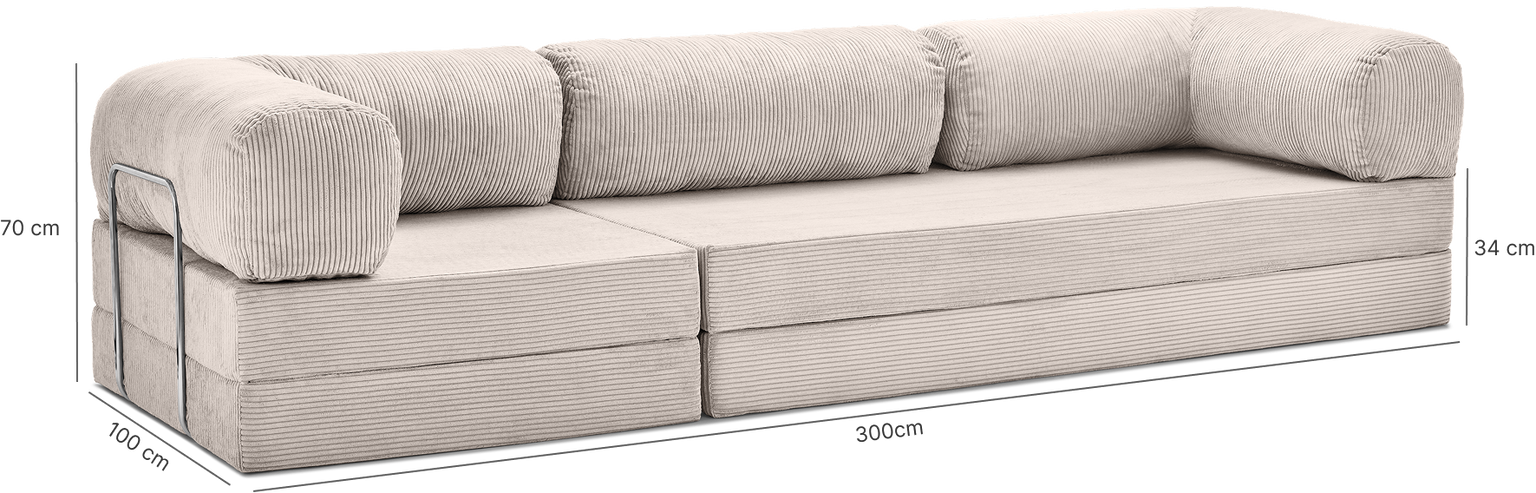
This is what most people picture when they say "sofa," and what most rooms are sized around.
- Standard width: 183 to 244 cm (6′0″ to 8′0″), with about 213 cm (7′0″) being the sweet spot.
- Depth: 81 to 102 cm (2′8″ to 3′4″).
- Best for: the main sofa in a living room, families, anyone who wants room to lie down.
3-seater sofa dimensions in feet: roughly 6 to 8 feet wide and 2.5 to 3.5 feet deep. If you only remember one number, a 7-foot (about 213 cm) three-seater fits the most rooms.
Worth knowing: a three-seater doesn't always seat three adults in comfort. Three seat cushions can mean three people, or two people plus a genuinely usable middle. Check the seat width, not just the label. A 213 cm (7′0″) sofa with three cushions gives each person about 61 cm (2′0″), which is fine. A shorter one splits the same space thinner.
Varies most because of: seat depth. The deep, sink-in sofas that are everywhere now push front to back well past the old standard, so two three-seaters with the same width can need very different floor space.
4-seater sofa (and larger) dimensions
The big statement piece, or the one that actually holds a whole family on film night.
- Standard width: 244 to 305 cm (8′0″ to 10′0″).
- Depth: 81 to 107 cm (2′8″ to 3′6″).
- Best for: large living rooms, open plan spaces, serious lounging.
At this size the room matters more than the sofa. A 305 cm (10′0″) sofa needs a wall to match and a walkway in front, or it dominates everything. Measure the wall first, then shop.
Varies most because of: configuration. Some four-seaters are one long bench, others are two doubles pushed together, and the join changes both the width and how it sits against a wall.
Sectional and L-shaped sofa dimensions

Now we're off the chart. Sectionals and L-shaped sofas are measured per side, because the whole point is they turn a corner.
- Long side: 239 to 305 cm+ (7′10″ to 10′0″+).
- Short side (the return): 152 to 198 cm (5′0″ to 6′6″).
- Depth: 86 to 112 cm (2′10″ to 3′8″), deeper than a straight sofa.
- Best for: corners, room dividers in open plan, households that want everyone facing the TV.
An L-shaped sofa is just a sectional with two runs at a right angle. To size one you need three numbers: the long side, the short return and the depth. A U-shaped sofa adds a second return, so measure all three sides.
The thing to nail down before you buy is orientation. A left-hand or right-hand chaise is decided by which way you face the sofa, and getting it wrong means the corner lands on the wrong wall. Our guide to L shaped sofas for small spaces walks through fitting one into a tight layout.
Varies most because of: everything. Shape, orientation, number of modules. There's barely a "standard" here at all, so measure both runs against your actual walls.
Modular sofas, ottomans and poufs
Modular sofas throw the size chart out on purpose. Instead of one fixed shape you buy pieces and arrange them, which is why a modular range can be a two-seater one week and an L-shape the next.
Standard piece sizes to expect:
Piece |
Width |
Depth |
Height |
|---|---|---|---|
Single module / seat |
71–91 cm (2′4″–3′0″) |
86–107 cm (2′10″–3′6″) |
71–91 cm (2′4″–3′0″) |
Ottoman module |
61–122 cm (2′0″–4′0″) |
61–91 cm (2′0″–3′0″) |
40–46 cm (1′4″–1′6″) |
Square pouf |
40–60 cm (1′4″–2′0″) |
40–60 cm (1′4″–2′0″) |
~40 cm (1′4″) |
An ottoman or pouf is how you turn a straight modular sofa into an L. Push one against the end and you've added a chaise. Add two and you can bridge into a flat lounging or sleep surface. That's the whole trick behind a modular corner: it's just standard pieces arranged to fit your room, not a single locked footprint. Varies most because of: you! That's the point of modular.
Sofa bed and sleeper dimensions

A sofa bed adds a second set of numbers: the bed it opens into. The bed size is fixed, the sofa around it is not.
Sofa bed |
Opens to (bed) |
|---|---|
Twin / single |
97 x 191 cm (3′2″ x 6′3″) |
Full / double |
137 x 191 cm (4′6″ x 6′3″) |
Queen |
152 x 203 cm (5′0″ x 6′8″) |
That's the short version. Clearance to fold out, closed footprints and the full US vs EU size breakdown are in our dedicated sleeper sofa dimensions guide.
Seat-level dimensions that barely change
Here's the flip side of all that variation. While overall width swings wildly by size, the numbers your body actually touches stay in a tight band across almost every sofa.
Measurement |
Standard range |
What it is |
|---|---|---|
Seat height |
43–51 cm (17–20 in) |
Floor to top of seat cushion |
Seat depth |
53–61 cm (21–24 in) |
Front of seat to back cushion |
Arm height |
61–81 cm (24–32 in) |
Floor to top of arm |
Back height |
76–91 cm (30–36 in) |
Floor to top of back |
Two of these are worth caring about:
- Seat height around 45 to 48 cm (18 to 19 in) suits most people. Too low and it's hard to get up from, too high and short legs dangle. Low floor-style sofas sit lower on purpose: our own TEDDY seat sits at 34 cm (1′1″) for a relaxed, loungy feel.
- Seat depth is where the "sink in" feeling comes from. Around 53 to 56 cm (21 to 22 in) sits upright and supportive. Push past 61 cm (24 in) and you get a lounger that's lovely for slouching and less good for sitting at the front to eat or work.
So the standard that matters most for comfort isn't the width. It's these.
Sofa cushion and pillow dimensions
Two different things get called cushions, so quick clarity.
Seat and back cushions are part of the sofa. Seat cushions run about 53 to 61 cm (21 to 24 in) deep, matching the seat depth above. You don't buy these separately, but their depth tells you how deep the sofa really sits.
Throw pillows (scatter cushions) are what you add on top. Standard sizes:
Pillow |
Size |
Use |
|---|---|---|
Small square |
45 x 45 cm (18 x 18 in) |
The default, the most common size |
Medium square |
50 x 50 cm (20 x 20 in) |
A fuller look, larger sofas |
Large square |
55–60 cm (22–24 in) |
Anchor cushions in the corners |
Lumbar |
30 x 50 cm (12 x 20 in) |
Lower-back support, a longer accent |
Rule of thumb: a two-seater carries two to three throw pillows, a three-seater three to five. Mix a couple of sizes rather than matching them all.
Sofa dimensions in cm, feet and inches
Same standard widths, three ways, for whichever unit you measure in.
Sofa |
Centimetres |
Feet |
Inches |
|---|---|---|---|
Loveseat (2-seat) |
132–183 cm |
4′4″–6′0″ |
52–72 in |
Apartment (compact 3) |
152–198 cm |
5′0″–6′6″ |
60–78 in |
Standard (3-seat) |
183–244 cm |
6′0″–8′0″ |
72–96 in |
Large (4-seat) |
244–305 cm |
8′0″–10′0″ |
96–120 in |
Sectional / L (long side) |
239–305 cm+ |
7′10″–10′0″+ |
94–120 in+ |
How to measure your space
Standard sofa dimensions are only half the job. The other half is the room.
- Leave a walkway. Keep about 60 to 90 cm (2′0″ to 3′0″) of clear floor in front of the sofa for a path and a coffee table.
- Check the route in. Measure the narrowest doorway, hallway and turn on the way to the room. A big sofa is rigid and unforgiving.
- Mind the wall. Match the sofa width to the wall it lives on, and leave breathing room at each end so it doesn't look wedged.
Tape the footprint on your floor before you buy. It's the cheapest reality check going.
Why the numbers vary so much
If you've read this far you already know the answer, but here it is in one place. Four things move a sofa off the standard:
- Arm style. A slim track arm and a fat rolled arm on the same seats can differ by 20 cm (8 in) or more in total width.
- Back height. Low, mid or high back changes the overall height and how bulky the sofa feels in a room.
- Seat depth trend. Deep loungy sofas are the fashion, and they push the front to back number well past the old standard.
- Overall vs seat. A sofa's outside dimensions and its usable seat space are not the same. Always check both.
That's why two sofas sold as the same size can feel completely different. Read the actual spec, not the category name.
The TEDDY approach
Fixed dimensions are the whole problem this guide is about. Our TEDDY modular corduroy sofa sidesteps it by not being one fixed shape.
TEDDY is built from pieces you arrange to fit. Here's the range:
TEDDY |
Width |
Depth |
Height |
|---|---|---|---|
TEDDY Sofa (2-person) |
200 cm (6′7″) |
100 cm (3′3″) |
70 cm (2′4″) |
TEDDY Corner Open |
300 cm (9′10″) |
200 cm (6′7″) |
70 cm (2′4″) |
TEDDY Corner Closed |
300 cm (9′10″) |
200 cm (6′7″) |
70 cm (2′4″) |
Start with the 2-person Sofa for a small room, add modules for a longer run, or set up a Corner for an L-shape that matches your wall. Add an ottoman to turn a straight run into a chaise. Same range, different footprint, decided by you. It comes in soft corduroy in a wide colour range too, so the fit isn't only about the numbers.
So instead of hunting for the one sofa whose standard dimensions happen to fit, you size the sofa to the space.

FAQ
What is the standard size of a sofa?
A standard three-seat sofa is about 183 to 244 cm (6′0″ to 8′0″) wide and 81 to 102 cm (2′8″ to 3′4″) deep, with around 213 cm (7′0″) being the most common width. But "standard" is a range, and arms, back height and seat depth all move it.
What are 3-seater sofa dimensions in feet?
Roughly 6 to 8 feet wide and 2.5 to 3.5 feet deep (about 183 to 244 cm by 81 to 107 cm). A 7-foot three-seater is the size that fits the most rooms.
How deep is a standard sofa?
Usually 81 to 102 cm (2′8″ to 3′4″) front to back. Deep loungy sofas go further, past 107 cm (3′6″), which is worth checking against your floor space.
What are the dimensions of a 2-seater sofa?
About 132 to 183 cm (4′4″ to 6′0″) wide and 76 to 102 cm (2′6″ to 3′4″) deep. A deep two-seater can be nearly as big as a small three-seater.
What size is an apartment sofa?
A compact three-seater, roughly 152 to 198 cm (5′0″ to 6′6″) wide, with slimmer arms and a lower back so it fits smaller rooms and doorways.
What are standard L-shaped sofa dimensions?
The long side runs 239 to 305 cm+ (7′10″ to 10′0″+), the short return 152 to 198 cm (5′0″ to 6′6″), at a depth of 86 to 112 cm (2′10″ to 3′8″). Measure both runs, and pick the chaise side to suit your room.
How many people fit on a 3-seater?
Three, in theory. In practice it depends on the seat width. A 213 cm (7′0″) three-seater gives each person about 61 cm (2′0″), which is comfortable. Shorter models split the space thinner.
What size throw pillows go on a sofa?
The default is 45 x 45 cm (18 x 18 in). Add 50 x 50 cm (20 x 20 in) or a 30 x 50 cm (12 x 20 in) lumbar for variety. A two-seater takes two to three, a three-seater three to five.


